
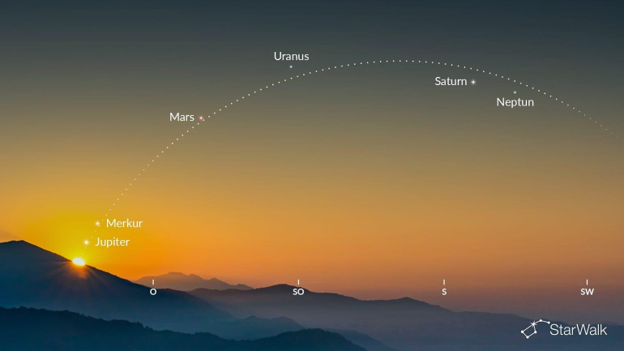
If you have ever dreamed of seeing multiple planets decorating the morning sky at the same time, 12 August 2026 is a date you should circle on your calendar. Before sunrise, six planets – Mercury, Jupiter, Mars, Saturn, Uranus, and Neptune – will appear stretched across the eastern sky in what astronomers popularly call a planet parade. While not all six planets will be visible with the naked eye, the event promises to be one of the most exciting astronomical spectacles of the year. (Star Walk)
For astronomy enthusiasts across India, this is an excellent opportunity to wake up early, set up binoculars or a telescope, and witness the Solar System displayed in a single panoramic view.
What is a Planet Parade?
Despite the name, planets do not actually line up in space. Instead, they appear to line up from our perspective on Earth because all the planets orbit the Sun in nearly the same plane, known as the ecliptic. During certain periods, several planets become visible in the same section of the sky, creating the illusion of a celestial parade. (Wikipedia)
The August 2026 event features six planets spread across the pre-dawn sky:
- Mercury
- Jupiter
- Mars
- Saturn
- Uranus
- Neptune
Each planet will occupy a different position and brightness, making the observation both exciting and slightly challenging.
Why is the 12 August 2026 Planet Parade Special?
Planetary alignments involving three or four planets occur fairly often, but six-planet parades are much less frequent. The August 2026 event becomes even more remarkable because it occurs during one of the busiest astronomical weeks of the decade.
Around the same period:
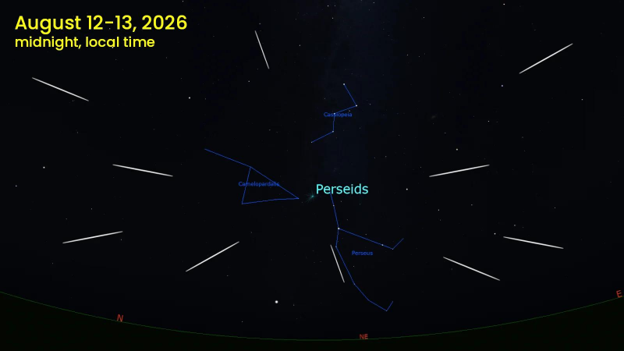
- The Perseid Meteor Shower reaches its peak,
- A Total Solar Eclipse occurs (visible mainly from parts of Europe and Greenland, not India), and
- The Moon is near its New Moon phase, providing exceptionally dark skies for morning observations. (Star Walk)
For observers in India, although the solar eclipse will not be visible, the dark skies created by the New Moon will improve the chances of spotting the planets.
Which Planets Can Indians See?
Not every planet will be equally easy to observe.
Saturn
Saturn will be one of the brightest and easiest planets to identify before sunrise. Even a small telescope can reveal its magnificent ring system.
Mars
Mars will appear as a reddish-orange object high enough above the horizon to be seen comfortably without optical aid.
Mercury
Mercury will remain close to the eastern horizon. A flat, unobstructed horizon is essential because the planet rises shortly before sunrise.
Jupiter
Jupiter will also lie low on the horizon. Although extremely bright, twilight may make it difficult to locate without careful timing.
Uranus
Uranus will require binoculars under dark skies.
Neptune
Neptune is too faint for binoculars and will require a telescope for observation. (Star Walk)
Best Time to Observe from India
Indian observers should begin preparing about 60–90 minutes before local sunrise.
The ideal observing window is approximately:
- 4:45 AM – 5:45 AM IST (depending on your city)
- Finish observations before the bright twilight washes out the fainter planets.
Cities such as Bengaluru, Hyderabad, Pune, Jaipur, Ahmedabad, Nagpur, Delhi, Chennai, and Mumbai with relatively open eastern horizons can offer excellent viewing opportunities if weather conditions remain clear.
Equipment You Need
One of the best aspects of this event is that expensive equipment is not necessary.
Naked Eye
Suitable for:
- Saturn
- Mars
- Mercury (under good conditions)
- Jupiter (low on horizon)
Binoculars
Recommended for:
- Uranus
- Better views of Mercury and Jupiter
Telescope
Necessary for:
- Neptune
- Saturn’s rings
- Jupiter’s cloud bands and moons
A pair of 10×50 binoculars can greatly enhance the experience.
Tips for Indian Skywatchers
To make the most of this celestial event:
- Find a location away from city lights.
- Ensure you have a clear eastern horizon.
- Reach your observing site at least 20 minutes before the session.
- Allow your eyes to adapt to darkness.
- Avoid using bright mobile phone screens.
- Carry binoculars if available.
- Use astronomy apps to identify planets in real time.
Why Planet Parades Fascinate Astronomers
Planetary parades beautifully demonstrate the architecture of our Solar System.
Although the planets appear aligned, they remain separated by millions or even billions of kilometres in space. Their apparent arrangement is simply the result of Earth’s viewing geometry.
Events like this provide excellent opportunities for:
- public outreach,
- astrophotography,
- telescope demonstrations,
- astronomy club observations,
- and introducing beginners to observational astronomy.
A Great Opportunity for Astrophotography
The August 2026 alignment offers photographers an exciting challenge.
Wide-angle landscape shots combining:
- temples,
- forts,
- observatories,
- lakes,
- mountains,
- or city skylines
with the aligned planets can create stunning compositions.
Long-exposure photography and tracking mounts can reveal even Uranus and Neptune under dark skies.
Perfect Timing with the Perseid Meteor Shower
Adding to the excitement, the Perseid Meteor Shower reaches its maximum activity around the same date. Since the Moon is near the New Moon phase, the sky will be exceptionally dark, allowing observers to enjoy both the planetary lineup before sunrise and meteors during the night. (WIRED)
Join Astronomy Clubs Across India
Many astronomy clubs and science organizations across India are expected to organize:
- telescope observation sessions,
- public skywatch events,
- astrophotography workshops,
- educational talks,
- and live online broadcasts.
If weather conditions are favorable, this could become one of India’s largest coordinated public astronomy events of 2026.
Final Thoughts
The Planet Parade of 12 August 2026 is much more than a beautiful arrangement of planets. It is a reminder of our place within the Solar System and an invitation to reconnect with the night sky.
Whether you are an experienced astrophotographer, an amateur astronomer, or someone simply curious about the universe, this event offers a memorable opportunity to witness six worlds sharing the morning sky.
So set your alarm, charge your camera batteries, prepare your telescope, and hope for clear skies. Sometimes, the greatest astronomical experiences happen just before sunrise.
For detailed viewing guidance, sky maps, and updates on the planetary alignment, readers can visit the Star Walk guide: Planetary Alignment August 2026 Viewing Guide.