
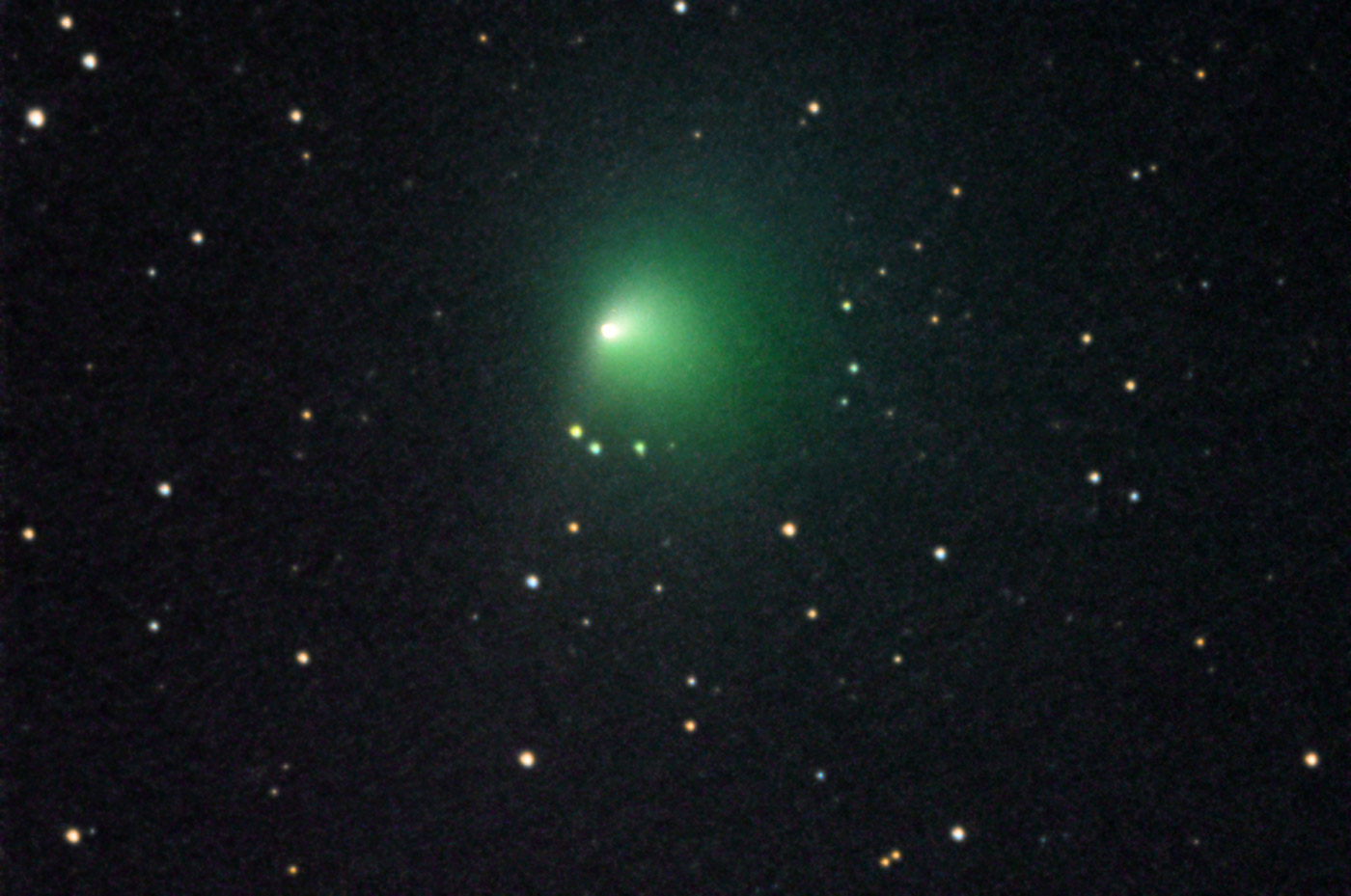
While stars burn steadily for millions or billions of years, occasionally an icy comet sweeps through the inner solar system, unfurling a glowing tail across the dark canvas. This midyear, the highlight of the night sky belongs to this fascinating celestial time capsule.
It isn’t just a usual faint smudge on a long-exposure photograph but is one of the largest and most highly evolved comets we know of and it is currently putting on its finest performance for skywatchers in decades.
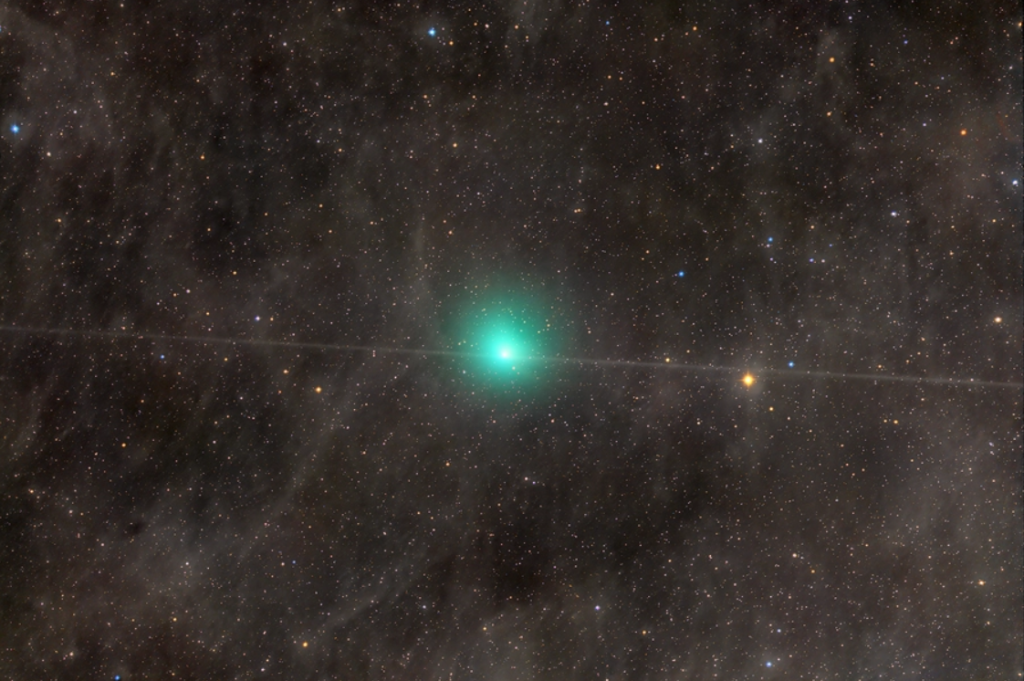
What Is the Discovery History and Orbital Period of Comet 10P/Tempel 2?
Comet 10P/Tempel 2 has a well-documented history that dates back more than a century which makes it an invaluable object for long-term orbital studies. It was first officially discovered on July 4, 1873, by the renowned German astronomer Ernst Wilhelm Liebrecht Tempel while observing from Milan, Italy. Shortly after its discovery, athematicians and astronomers calculated its trajectory and identified it as a short-period comet within the inner solar system.
How Big Is Comet 10P/Tempel 2 and What Is Its Orbit?
Discovered on July 4, 1873, by the prolific German astronomer Wilhelm Tempel, this comet is what astronomers call a Jupiter-family Comet. This means its orbit is shaped and controlled by the massive gravitational influence of Jupiter. At 10.6 kilometers in diameter, the nucleus of Tempel 2 is roughly the size of a massive city, pretty much as huge as the asteroid that brought an end to the era of the dinosaurs.
Thankfully, its path keeps it safely away from us. It travels on an eccentric orbit that takes 5.37 years to complete and swings from the outer edges of the main asteroid belt (near Jupiter) down to just outside the orbit of Mars. Unlike stars which glow due to intense nuclear heat, a comet glows because of sublimation. As it nears the Sun, its frozen carbon dioxide, water, and methane turn directly from ice into gas, creating a massive atmosphere called a coma and a long, reflective dust trail.
When Is the Comet 10P/Tempel 2 Closest Approach to Earth in 2026?
Comets are notorious for alternating between “favorable” and “unfavorable” appearances. Because its orbit takes nearly five and a half years, Earth is often on the completely wrong side of the Sun when the comet lights up. In 2026, however, the geometry is nearly perfect. The comet reaches its closest point to the Sun (perihelion) and its closest point to Earth within a 24-hour window, making it exceptionally bright.
| Date (2026) | Expected Magnitude |
What to Expect |
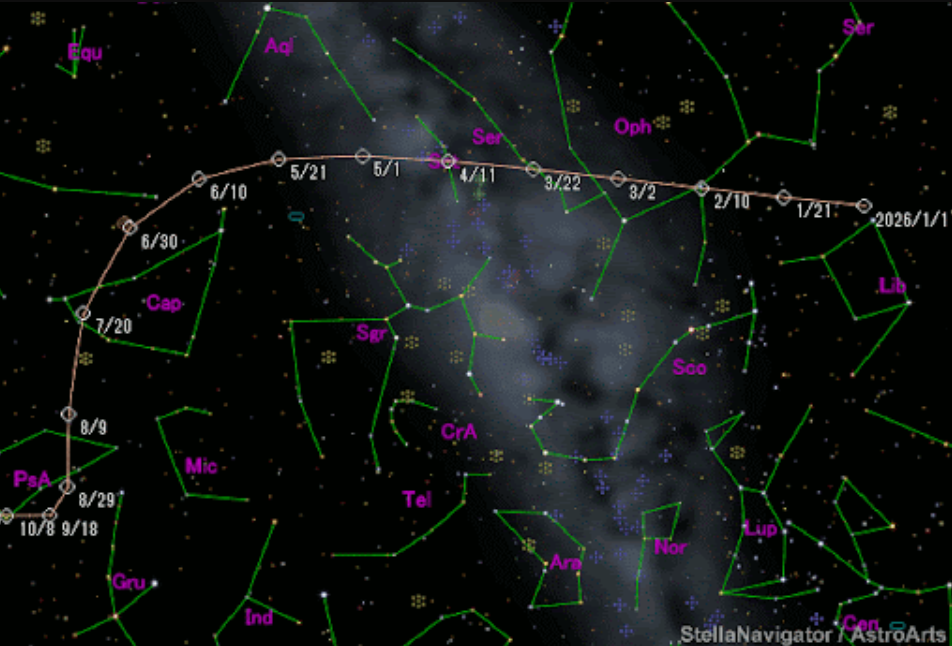
| July 10 – July 16 | 9.0-10.0 | Dark skies for tracking the comet early in the constellation Capricornus. |
| July 26 – July 29 | 7.8-8.5 | The comet passes within 0.5° of the beautiful globular cluster M30. |
| August 2 | 7.0-8.0 | The comet reaches its closest approach to the Sun, triggering maximum gas and dust activity. |
| August 3 | 7.0-8.0 | Sweeping past Earth at a safe 62 million kilometers (0.414 AU), the comet peaks at an estimated magnitude of 7.0 to 8.0. |
| August 12 | 7.0-8.0 | A window to view the fading tail against a black sky. |
Why Is the Rotation Period of Comet Tempel 2 Slowing Down?
One of the most mind-blowing secrets astronomers have uncovered about 10P/Tempel 2 is that it is slowing down. By studying the light curves of the comet over the last few decades, scientists have noticed that its rotation period increases by roughly 32 seconds every few orbits. Currently, it takes about 8.95 hours to complete a single spin on its axis.
Why is this happening? The comet has a highly localized jet near one of its poles that spews out gas asymmetrically. As this gas blasts out into space like a thruster, it creates a subtle torque that acts as a planetary brake, gradually dragging the comet’s rotation to a slower pace.
Can You See Comet 10P/Tempel 2 with Binoculars or Telescopes from Mumbai?
The short answer is Yes, but you will need optical assistance and dark skies.
At a peak magnitude of roughly 7.0 to 8.0, Comet Tempel 2 will remain just beyond what the naked human eye can see without assistance. Because Mumbai’s city lights create heavy light pollution, you won’t be able to spot it from your balcony in Mumbai.
However, it is a prime target for astronomical binoculars or a small telescope. Here is how to find it:
- The Location: Throughout late July and early August, look towards the constellations Capricornus and Piscis Austrinus in the late-night sky. By mid-August, it will pass remarkably close to Fomalhaut, the brightest star in the southern fish constellation.
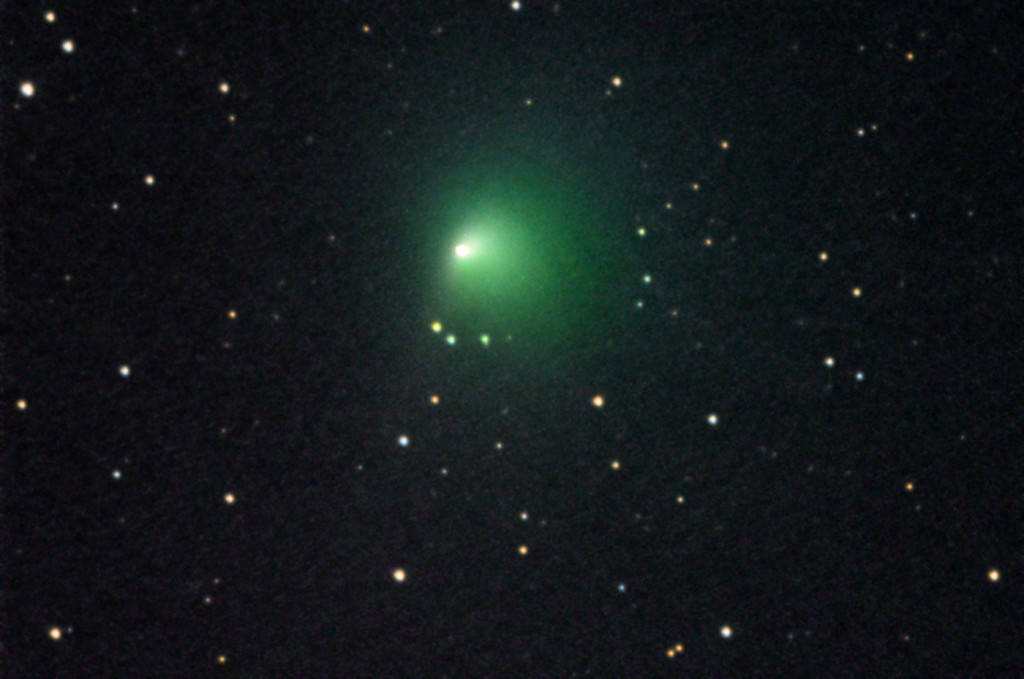
- The Appearance: Do not expect a blazing streak like you see in Hollywood movie. Through binoculars under a clear sky, Tempel 2 will probably look like a delicate, ghostly “fuzzy ball” with a brighter central core and a distinct green coma with a short dust tail structure.
What Do Astrophotography and Core Samples of 10P/Tempel 2 Reveal About the Solar System?
Since Comet Tempel 2 is highly evolved, less than 1% of its surface is still actively outgassing. The rest of the nucleus is blanketed in a dark, tar-like crust created by billions of years of solar radiation interacting with carbon-based molecules. By analyzing the chemical signature of the dust trail and the green diatomic carbon emissions captured in astrophotography, astronomers are essentially looking at ingredients from the birth of our solar system from almost 4.6 billion years ago.
Want to see the comet through a professional telescope? Book your spot on an upcoming Stargazing Mumbai tour or join us at our Stargazing sessions at Bhandardara or Mahuli for guided observation sessions.
If you enjoyed this deep-dive into Comet 10P/Tempel 2, check out our other informative astronomy blogs: